CHINESE KEYBOARD PROJECT
On my interest about finding a good keyboard for Chinese, I found two types of keyboards, the two most logical ways to type Chinese with a limited number of keys. Chinese is a language where every word is represented by its own graphical character and thus each is encoded separately, meaning you cannot asign every one of them to its own key, so what are these two solutions Chinese found?
CATEGORY 1: PHONETIC
What the Chinese language does NOT have a ridiculous amount of is sounds, and it is much easier to map these to a keyboard with the typical number of keys whether it's pinyin or bopomofo. This system works great when you know how something is pronounced but not written visually, however, in my opinion, these take away a lot of the beauty of the Chinese writing system, especially pinyin where someone just decided to adapt the latin alphabet to yet another language that wasn't designed for it, because we didn't have enough of those.
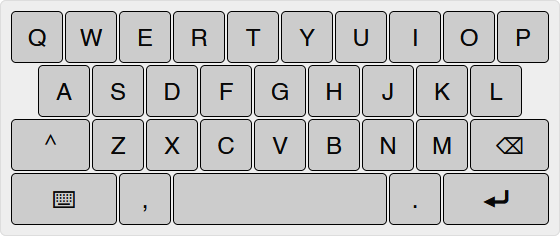
Example of a Chinese pinyin keyboard.
CATEGORY 2: GRAPHIC
The other type of keyboards for writing Chinese that I found are graphical component-based, in which the keys you are given are simple, common, widely-used radicals or graphical pieces in general, that you can combine to type out a more complex character. In a way some of these are kind of like drawing the text, except instead of literally drawing you are choosing the puzzle pieces in the correct order.
Out of the ones that fall in this category, two really stood out to me, and I wanted to focus on them, I am talking about the Wubizixing method and the Wubihua method, which for simplicity I will refer to them as the 25-Key and the 5-Key methods. So how do they work? I want to explain each of them because the two of them are kind of like two sides of the same coin in a way. In fact, you'll notice both of them have "Wubi" (五笔) as part of their name, this translates to "Five strokes" and is the base both keyboards are based on: the 5 basic types of pen strokes in writing.
Has anyone else noticed everything about Chinese culture seems to come in fives?
THE 5-KEY "WUBIHUA" METHOD
The core idea about both of these systems is that every single Chinese character can be built with strokes that fall into the following five types: 1. Horizontal (⼀), 2. Vertical (⼁), 3. Left falling (⼃), 4. Right falling/Dot (⼂), 5. Turn/Bend (⼄), and by asigning each of those a number, every complex character can be encoded as a string of numbers made up of digits from 1 to 5. for example, the character 我 would be encoded as "3121534", so if you pressed the corresponding keys "⼃⼀⼁⼀⼄⼃⼂" you would get this character. Well, of course nowadays we also have predictive text and considering 我 is such a common character it'd probably be near the top of the suggestion lists by the time you press the very first key, but for any characters that don't, the method I said would eventually help finding anything you need.
It's easy to see how this layout was optimized for a numpad like those in older phones without touch screens, this helps simplify things as you don't really have to memorize anything that you shouldn't already know from what the characters look like, except for stroke order of course.
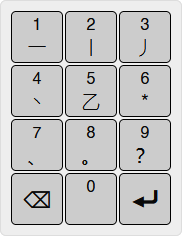
Example of a 5-Key board.
PROS: Very few keys, even if you forget how one character is constructed you normally have a blank key that stands for "any stroke" helping with skipping the one you don't know while still aiming for the number and order of the ones you do know. but even then with such few keys it won't take much trial and error to get the correct combo, and once again, the predictive text that these keyboards have nowadays helps accessing the most common characters with one or two key presses, you'd hardly ever need to go for a full key combo because you'd get the suggestion you need much earlier than that.
CONS: The characters that you do need to type in text are not immediately visible to you, which makes this feel less like our form of typing with a latin keyboard and more like having to physically draw the characters or enter passwords to get them, and if you do need to press more than 2 or 3 keys it can start getting unreasonably long key combo for a single character, making it not so efficient.
THE 25-KEY "WUBIZIXING" METHOD
Similar to the previous method, the 25-key board also classifies characters by their starting stroke types, which are the same five (⼀, ⼁, ⼃, ⼂, ⼄), however, it makes use of 5 times more keys by making each of them its little row of further specific keys. Normally these will imply pairs of strokes such as the ASDFG row being all horizontals followed by each of the five as a second (or some other later) stroke, or they'll even be grouped by visual similarity too which is a good idea. Apart from that, each key may also have some purpose related to disambiguation or acting as shortcuts for common complex characters.

Guide for a 25-Key board.
The biggest problem I find with this method is that it can get pretty complicated to remember all the functions each single key can have. I watched a video about this layout and what I learnt is that apparently each full character needs a 4 key code and sometimes this may involve pressing the same key 4 times for simple ones, pressing a couple and then some blank key to indicate there is nothing more to add, or using the central keys as first, second and last strokes of a character that isn't on the chart, or using some as disambiguation... It got too confusing, this is a system that honestly seems it was designed by a several robots who had different ideas and they all got picked somehow, which is a shame because at first glance it looks so organized and elegant, Look at all the boxy characters all in the same corner! Good luck knowing how to use them though.
PROS: With more keys, each of them can be assigned to more complete or complex looking radicals/characters grouped by visual or structural similarity, which gets closer to the level of simplicity to efficiency ratio that the latin keyboard has in comparison to 5 keys with a moderately distinct-looking line each. You also would need less key presses to construct complete characters which I believe is either 2 or 4 each time.
CONS: The complexity, the need to press a specific 2 or 4 key long code for each character brings back the feeling of typing passwords that you better get right or have a guide in hand, the several methods to do so with all the different ways each signe key can be used be it for its base character, its shortcut character, its group of radicals or its disambiguation stroke... it is considered a pretty hard to learn method.
SO WHAT DO I DO ABOUT THIS?
I ask myself the very same question I ask about everything ever: What would the middle stage between these two things be like?
Let's look at the pros for both, The 5-Key one is super simple, you know what each of the total 5 keys do and using them is as easy as actually drawing the text the way you would do on paper. The 25-Key one has more keys, each one with a theme and a group of radicals assigned to it, and you don't need to worry about every single stroke, just the category of radicals. What about the cons to avoid? The 5-Key one is a bit too deconstructed, it may require too many key presses for a single character in some cases because you don't have shortcuts for common stroke combos and shapes and you are required to do each one in the correct order. The 25-Key one is too technical with different types of codes and shortcuts that seem like they were designed for speed in its core, but part of what makes a system speedy must be how intuitive it is, and this one doesn't look like an intuitive method (or group of methods sewed together).
That being said, the neat-looking sorting of the 25-Key method is on the right track for me, so I will analyze how the characters are grouped.
25-KEY SORTING
Group 1 - Horizontal row.
1.1 ⼀㇀, 王五戋
This key seems to be the quintessential horizontal stroke key, it represents the single stroke as well as characters that start with two of them in a row.
1.2 二, 土士干寸十地, 申雨亞
This key represents crosses, a horizontal followed by a vertical going through, plus characters that look like crosses or contain something similar.
1.3 三長, 大犬厂古石在
This key seems to represent two things, either characters with three horizontals in a row, or characters with a horizontal followed by a left falling stroke. Then there's 古, likely by association with 石.
1.4 木, 丁西襾要
This is where a horizontal plus a dot would be, but this combination doesn't seem to happen. 木 has these two but with other two strokes in the middle. The rest are what I call "roofs".
1.5 工, 戈弋七匚匸, 廾廿
This key has 工 which vaguely connects to the true theme, horizontals plus bends to the right. 廾 is probably just in association to 廿 which also contains these.
Group 2 - Vertical row.
2.1 丨亅卜上止, 目且
This key opens with verticals in general, mostly followed by a stroke towards the right, and additionally, boxy characters with many horizontals.
2.2 刂, 日虫早是, 井片爿
This one kinda confuses me about what the theme is meant to be, we have boxes divided by the middle and some that have two vertical lines but not super similar to eachother.
2.3 川, 口中
There are only a couple of things in this one, a triple vertical, a square and a square with a vertical.
2.4 囗国四皿田車
Once again there aren't verticals followed by dots, this key is occupied by boxes and enclosures.
2.5 山由, 同冂几冎贝貝
This key is populated by other types of encolsures which are open at the bottom, and apparently a couple square-ish characters with a tip at the top.
Group 3 - Falling row.
3.1 丿, 禾和, 竹彳攵 夂
This key contains some radicals starting with a left falling stroke, mostly followed by a horizontal stroke either coming from it or under it.
3.2 白的, 手扌斤
On this key there are different types of characters that start with left falling. either a small one followed by vertical or a wide one at the top.
3.3 有月用丹乃, 爫氏, 彡豕
This key seemingly has 3 themes, one is square-ish characters sloped on the left, another is sloped roofs, and the third is triple falling which fits with this being the left falling + left falling key.
3.4 人入八癶
This key has a simple clear theme about characters with mirrored falling strokes.
3.5 勹夕角钅, 乂儿, 金
This one contains characters that I'd describe as shaped like the japanese character "ku" as well as a couple that are also kinda similar to the previous key but different enough I suppose.
Group 4 - Dot row.
4.1 ⼂, 亠广文方主言讠
This key is made up of many things that begin with a dot at the very top
4.2 立六辛产䒑, 冫丬疒门門
The theme for this key seems to be double dots, especially as part of side/top radicals, though also 門 for association with 门.
4.3 水小少不, ⺍氵
This key has a couple radicals that look like they're formed by 3 dots, as well as their more full forms which actually begin with a vertical.
4.4 火米业亚为, 灬
The theme I can see for this key is characters with dots at each side. it also continues the theme of repeated dots and has the combining form 灬 with 4 of them.
4.5 之这辶廴礻, 宀冖
For this key the theme is side and bottom combiners I don't really have a name for but which start with a dot and wrap around as if carrying the rest of the character, plus a couple of "hats".
Group 5 - Bend row.
5.1 乙ㄋ乚己巳尸民羽, 心忄
This key has some zig-zag-like bends and some charactes that look square or flat at the top and have a bend at the bottom, 心 seems like an outlier except for having that same type of tail as others.
5.2 ㄍ, 子孑了阝ㄗ乜也ㄩ
This key starts with the double bend and of course, bends followed by a vertical (or another bend that starts of downwards).
5.3 巛彐臼, 刀九女发
This key has a triple bend and some characters with repetition that start with a bend. The other theme is bends followed by left-falling, in the case of 发 it happens twice even.
5.4 又厶以, 巴马馬
For this key I see two themes, a bend followed by a dot, and a bend that does kind of like an s shape and loops around the bottom in some way.
5.5 糸纟经, 匕七弓彑, 黽龜
This is the bend + bend key so it contains some characters with visual repetition like 糸 or just two bends somewhere. as well as these drawings of creatures that may start with a bend or just wouldn't go anywhere else so they put them in the final key or something.
ANALYZING ONE MORE SYSTEM
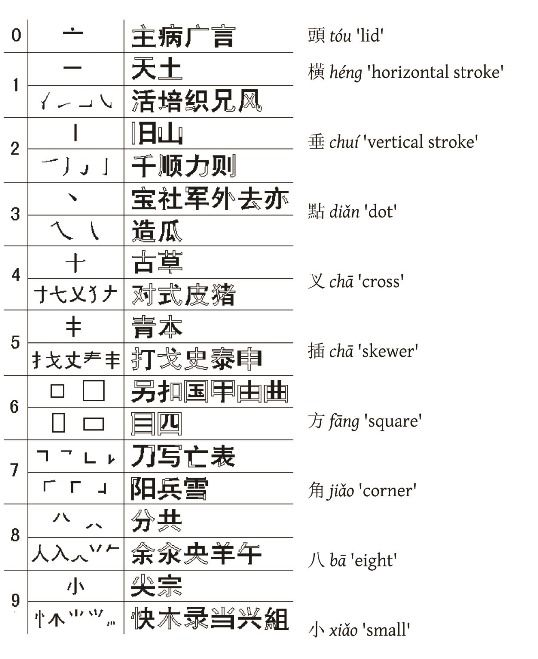
While I was writing this page I found something that seemed pretty helpful, this is less so an input method and more so an encoding method for chinese characters in which they're classified by the shape of whatever elements can be seen at each of the 4 corners, and for doing so they chose 10 distinct features, some of which are several strokes isntead of one, and these serve as a useful range of shapes that we can use.
Out of these 10, four of them are 4 out of the 5 types of strokes mentioned previously: Horizontal, Vertical, Dot and Corners. (Note that vertical includes left-falling, even if this type of stroke isn't very vertical sometimes like the at the top of ⼿). The other six are the cross, the skewer (one line going through several as opposed to the cross which is only through one), the rectangle, the "eight" shape which involves two mirrored falling strokes, the "small" shape which includes usually three branching lines or dots and finally the lid or hat.
In addition, I have a couple things I'd want to add, I want to distinguish between certain types of rectangular elements, one for simple squares, boxes and enclosures and another one for sectioned rectangles. I also wanted to add one that could stand for radicals with sides made out of curves like "knife" or "moon" shapes, it's a bit vague but if you see them together I think you'll see the theme (勹刀乃攵夕方丹月)
一 十 手 丨 口 日 丿 人 夕 丶 亠 小 乙
REWORKING THE SORTING
Let's look at the list of all radicals together.
⼀ ⼁ ⼂ ⼃ ⼄ ⼅ ⼆ ⼇ ⼈ ⼉ ⼊ ⼋ ⼌ ⼍ ⼎ ⼏ ⼐ ⼑ ⼒ ⼓ ⼔ ⼕ ⼖ ⼗ ⼘ ⼙ ⼚ ⼛ ⼜ ⼝ ⼞ ⼟ ⼠ ⼡ ⼢ ⼣ ⼤ ⼥ ⼦ ⼧ ⼨ ⼩ ⼪ ⼫ ⼬ ⼭ ⼮ ⼯ ⼰ ⼱ ⼲ ⼳ ⼴ ⼵ ⼶ ⼷ ⼸ ⼹ ⼺ ⼻ ⼼ ⼽ ⼾ ⼿ ⽀ ⽁ ⽂ ⽃ ⽄ ⽅ ⽆ ⽇ ⽈ ⽉ ⽊ ⽋ ⽌ ⽍ ⽎ ⽏ ⽐ ⽑ ⽒ ⽓ ⽔ ⽕ ⽖ ⽗ ⽘ ⽙ ⽚ ⽛ ⽜ ⽝ ⽞ ⽟ ⽠ ⽡ ⽢ ⽣ ⽤ ⽥ ⽦ ⽧ ⽨ ⽩ ⽪ ⽫ ⽬ ⽭ ⽮ ⽯ ⽰ ⽱ ⽲ ⽳ ⽴ ⽵ ⽶ ⽷ ⽸ ⽹ ⽺ ⽻ ⽼ ⽽ ⽾ ⽿ ⾀ ⾁ ⾂ ⾃ ⾄ ⾅ ⾆ ⾇ ⾈ ⾉ ⾊ ⾋ ⾌ ⾍ ⾎ ⾏ ⾐ ⾑ ⾒ ⾓ ⾔ ⾕ ⾖ ⾗ ⾘ ⾙ ⾚ ⾛ ⾜ ⾝ ⾞ ⾟ ⾠ ⾡ ⾢ ⾣ ⾤ ⾥ ⾦ ⾧ ⾨ ⾩ ⾪ ⾫ ⾬ ⾭ ⾮ ⾯ ⾰ ⾱ ⾲ ⾳ ⾴ ⾵ ⾶ ⾷ ⾸ ⾹ ⾺ ⾻ ⾼ ⾽ ⾾ ⾿ ⿀ ⿁ ⿂ ⿃ ⿄ ⿅ ⿆ ⿇ ⿈ ⿉ ⿊ ⿋ ⿌ ⿍ ⿎ ⿏ ⿐ ⿑ ⿒ ⿓ ⿔ ⿕
Next let's separate it into lists.
| 一 |
十 |
手 |
⼁ |
口 |
日 |
丿 |
人 |
刀 |
丶 |
亠 |
小 |
乙 |
又 |
This is a good start but smaller and neater sub-groups should be made, especially based on shape, and on top of that the more complex radicals definitely look like they could be composed from smaller ones, even if this is more due to pattern convergence rather than them being actually composite characters, so many radicals could take more than one keypress, but that's fine, there can be ways to make this not too bad later. On top of that we can also combine radicals that use the same tupes of strokes in the same order like the pairs 人入, 匚匸, 土士, which in fact there's precedent for.